
Drive documentation · for tour operators & DMCs
Every night is booked. Almost none of the day is.
On a self-drive holiday you confirm every bed and almost nothing in between. The six hours from check-out to check-in is where the holiday actually happens — and it is the one part most operators hand over as a map link and hope for the best.
Would rather talk first? Contact the team.
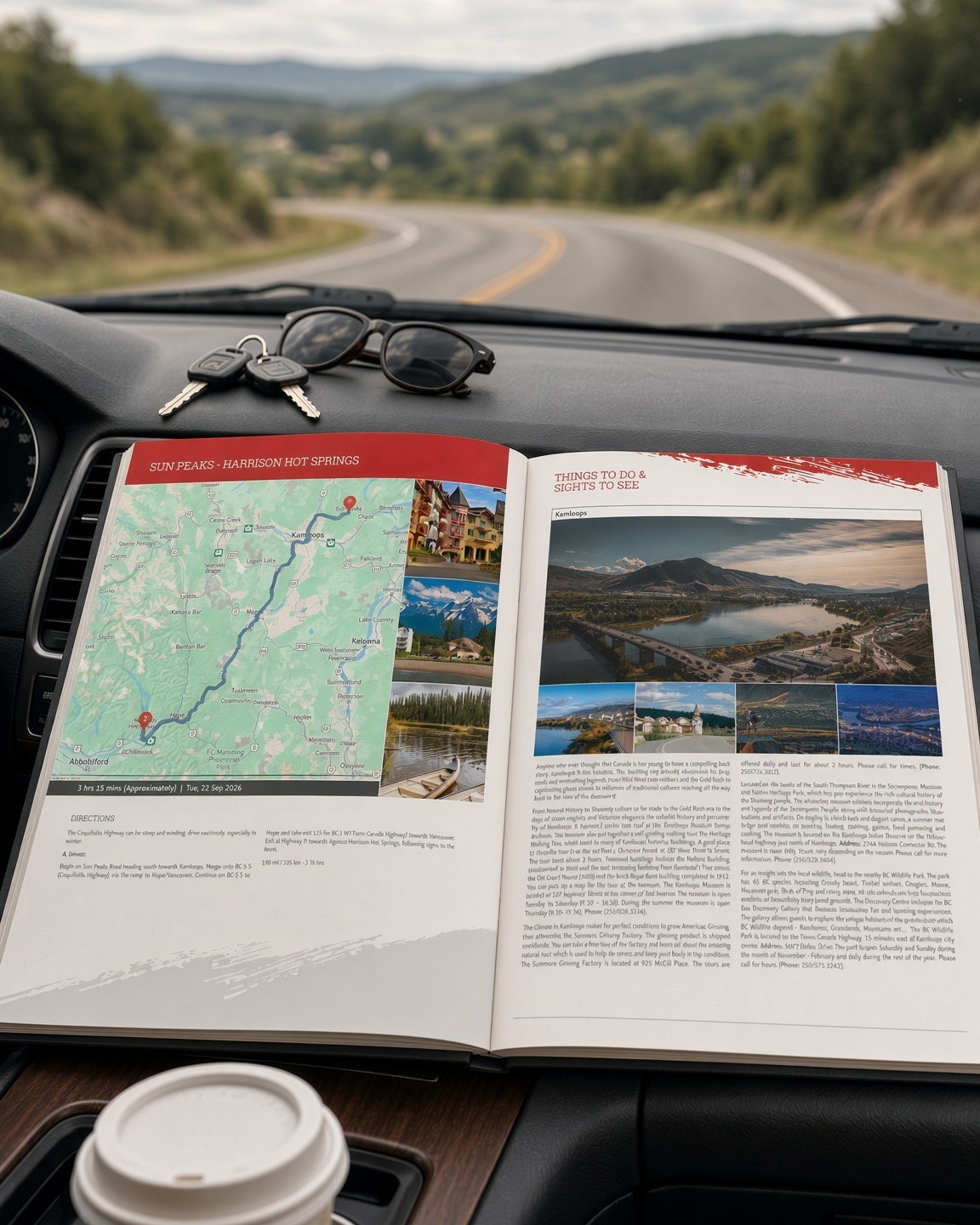
The undefended hours
Your reservation system stops at the hotel door.
It knows the flight, the car, the eleven nights and the transfer. It knows nothing about the four hours between Queenstown and Franz Josef, or the 380 kilometres from Swakopmund to Etosha — which is exactly where your client spends their day, makes every discretionary decision, and forms the opinion they will repeat to their friends.
Every content library in travel is organised around places you arrive at. A drive client does not arrive at a place. They arrive at eleven, and they live the holiday on the roads between them.
Everyone documents the destinations. Nobody documents the road between.
Why a link is not enough
The signal fails on exactly the roads you sell.
This is not an argument about taste. It is measured, published, and getting worse.
of Scotland's A-roads and motorways have in-vehicle 4G from all operators — so around a third of main-road Scotland is dark on any given network. The scenic routes run on lesser roads than that.
Ofcom Connected Nations, Nov 2025square kilometres — about the size of New South Wales — removed from Telstra's published coverage footprint in 2026 when the regulator required honest mapping.
Reported July 2026is how the New Zealand government describes its own highway mobile coverage: discontinuous by design, and sign-posted as such.
NZ National Infrastructureof travellers reading printed guides were influenced to visit somewhere they had not planned — and 69% of them were in their own or a hire car at the time.
Visitor International, 5,300 travellers, 2025And print is not the rival of digital here. 88% of those readers said the printed piece prompted them to go online. Paper carries the day; a scan carries the booking. The two work together, and only one of them works without a signal.
What we hold
We do not look the road up. We already know it.
Didgigo holds a single authoritative version of every route we document — researched once, improved continually, and reused across every operator selling that corridor. Not generated on request. Not scraped when the order comes in. Held, and kept current.
That is the part nobody else has. Routing software can tell you the road exists and how long it takes. Destination libraries can tell you about the town at the end of it. Only a route library can tell you what is worth stopping for between the two, and what it costs your client in time to go and see it.
Researched once, used always
One master version of each route. Every document that crosses that road draws on the same maintained content — so quality compounds instead of being rebuilt per booking.
Six languages
The same route, properly written for your market rather than machine-translated at the last minute.
A route library, not a stack of one-off jobs
Every corridor is built once, held as a master version and reused — extended each time an operator commissions a new one. Nobody else in the trade holds one.
Print and digital from one source
The same route content becomes a printed RoadBook, a PDF, an interactive proposal and the Tripigo app — without anyone retyping it.
What's inside
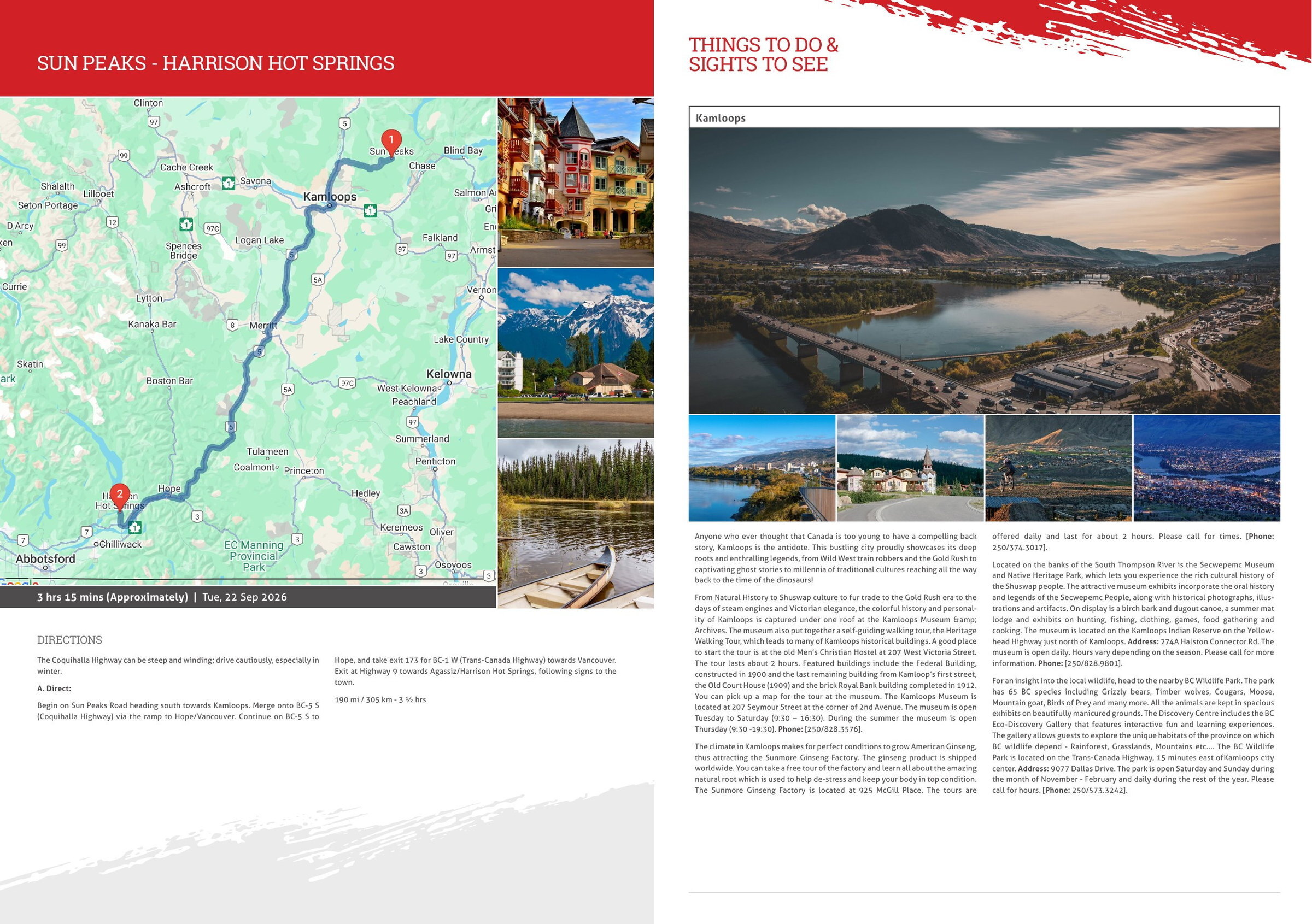
Organised by driving day, not by destination.
This one structural choice is what makes a document usable at eleven o'clock in the morning on a road, which is when your client actually opens it.
Kawarau Gorge
The road follows the river for 20 km. Pull-outs on the left give you the gorge without leaving the highway.
Cardrona Hotel
1863 facade, and the last proper coffee before the pass. Worth the detour if you left Queenstown before nine.
Blue Pools track
Forty minutes return on a flat track. Add an hour to the day if you stop — and it is the one most people say they would not have found.
Franz Josef
Check-in from 14:00. Last fuel is at Haast, 120 km back — fill up there, not here.
Stops carry a cost and a reason
Distance off route, minutes added, and one line on why it earns them. Any app can give you the first two. The third is the whole product, and it cannot be generated — only known.
Pacing that respects the day
A 640 km day with six recommended stops is a document that lies to your client. Stop selection is built against realistic drive time, not against how much content we could fit.
Road and season truth
Unsealed sections, seasonal closures, fuel gaps, and whether a standard hire car will make it. Two documented Australian stranding incidents this year traced back to online maps routing tourists onto closed or unsuitable roads.
Where the signal dies
Marked on the day, so your client knows before they lose it — and knows why the book in the glovebox matters. Nobody else does this.
Not a prototype
Around 50,000 travel documents a year already run through this.
Across Europe, the United Kingdom and Australia, for operators, DMCs and advisors whose clients need the document in their hand to be as considered as the trip inside it. The research, the routes, the approvals, the printing, the shipping — all of it, delivered.
Your branding on every page. We stay behind the operator, where we have always been.
What we don't do
Nothing in the book was paid for.
A drive document only works if your client believes the stop is genuinely worth forty minutes of their day. The moment one entry could have been bought, every entry is in question — and the document stops being a reason to choose you.
- No advertisingNot one page, not at any tier, not at any price. An entry earns its place because it is worth the detour, or it is not in the book.
- No paid placementNo supplier buys a mention, a ranking or a map pin. What we recommend is what we would recommend to a friend making the same drive.
- No generated contentRoutes are researched and written, not produced on request by a model reasoning over the open web. If we have not verified it, it is not in there.
- No competing for your clientThe book carries your brand. We do not sell to your traveller, and we do not put ourselves in front of you.
The conversation
Send us a route you already sell.
Pick one corridor from your current programme and we will build the driving days for it — stops, costs, road notes and all — so you can put our document next to the one you send today and decide from there.
Sources: Ofcom Connected Nations Scotland, November 2025; Telstra coverage remapping reported July 2026; National Infrastructure Funding and Financing (New Zealand); Visitor International brochure research 2025 (5,300+ travellers, 12 countries — figures measured among printed-guide users). Day 6 example is illustrative.